
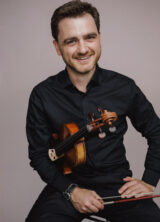
Nathaniel Anderson-Frank — “The freelance community is so relied upon and yet there’s no official safety net…”

When a sudden hand injury threatened violinist Nathaniel Anderson-Frank’s career, he faced the possibility of never playing again, but support from Help Musicians helped him recover, return to performance, and rebuild his career.
At the height of a demanding and fast-moving career, violinist Nathaniel Anderson-Frank was living the reality many musicians strive for — performing relentlessly, balancing orchestral work with chamber music, and navigating the pressures of a self-employed life in music. With a diary packed months in advance and momentum building, everything pointed toward a breakthrough moment. Then, in an instant, it all stopped.
A sudden, traumatic hand injury brought Nathaniel’s career to an abrupt halt, forcing him to confront not only the physical uncertainty of whether he would ever play again, but also the emotional and professional fallout that comes when your identity and livelihood are tied so closely to your craft.
A decade on, marking ten years since his injury with a performance at the BBC Proms at the Royal Albert Hall, Nathaniel reflects on that pivotal chapter: the intensity of life before the injury, the uncertainty and disorientation that followed, and the crucial role that specialist support from Help Musicians played in his recovery. With the charity’s backing, he was able to access tailored rehabilitation that went beyond simply restoring movement — it helped him reconnect with music itself.
From the brink of losing his career to performing at one of the world’s most prestigious classical music stages, Nathaniel’s journey highlights the profound impact that the right support, at the right time, can have.
“It happened in the middle of a quartet rehearsal, the accident, in my quartet mate’s kitchen. I looked down and just saw blood and was like… this looks bad.”
What followed was a period of shock, adaptation, and resilience — one that exposed both the precarity of a freelance music career and the strength required to rebuild it.
The early weeks of recovery were defined by emotional strain piled on top of physical limitation. With his left hand out of action and no clear sense of how – or if – he would return to the violin, Nathaniel found himself navigating unfamiliar territory.
“The first four to six weeks… I was really low,” he recalls. “I wasn’t thinking about playing the violin at that point. It was more just about my mental health.”
Daily walks became a way of regaining structure, while unexpected sources of inspiration – including stories of Olympic athletes returning from serious injury – helped to reframe what recovery might look like. “I kind of had to believe that I could do it; that I was going to get better.” he says.
As the immediate shock gave way to a longer rehabilitation process, the scale of what lay ahead became clearer. Standard treatment could only take him so far. “The NHS can get you to 75 per cent… but that last 25 per cent, you need the extra,” he explains. For a concert violinist, that final margin – the difference between basic function and elite performance – was everything.
It was at this point that Help Musicians stepped in, providing a grant that enabled him to access specialist hand therapy with musician-focused clinician Katherine Butler. “That was really key,” he says, “being able to see her on a regular basis and have that level of specialist monitoring.”
What set that support apart was not only its technical precision, but its understanding of the wider impact of injury on a musician’s identity.
“I was given hope when I saw Kathy. She really lifted me in so many ways and gave me hope that this was an injury that I could recover from. She herself is a musician and she’s worked with a lot of musicians.”
Butler’s approach went beyond restoring movement, reconnecting Nathaniel with music itself. “Even before I’d seen her, she said, ‘get your violin out and play some open strings,’” he recalls. “I was like… what, really? but it was so wise.” That early encouragement to play in whatever way he could, became a turning point. “You need something that reconnects you to what it is that you’re missing,” he says. Later, when he was able to do more, her advice remained simple: “Play what you love.”
Crucially, the support also helped him navigate the non-linear nature of recovery, both physically and emotionally. “Recovery is complex… you’re going to have good days and bad days,” Nathaniel reflects. Having someone who understood both the demands of performance and the psychological toll of injury made all the difference. “It was that sense that someone understands what you’re going through,” he says – a feeling that extended beyond clinical care to something closer to reassurance.
Gradually, progress gave way to possibility. Just months after the injury, Nathaniel found himself back on stage – tentatively at first, then with growing confidence. Rebuilding the strength in his hand also helped him rebuild the focus and resilience that performance demands. “I got back on stage about three and a half months after the accident,” he recalls. “I just sat in the back… and played one piece.”
From there, step by step, he rebuilt towards full performances. Crucially, the support he received throughout that process remained inseparable from what followed. “I would say the support is inextricably linked,” he says, reflecting on returning to high-level performance and ultimately securing his place within the BBC Concert Orchestra.
Looking back, the experience reshaped more than his career trajectory – it fundamentally changed how Nathaniel understands himself as a musician and as a human. The injury exposed the fragility of a life built in music, but also the strength of the networks that sustain it.
“The freelance community is so relied upon, and yet there’s no official safety net. Help Musicians really fills a vital role in providing that.”
In moving from crisis to recovery, Nathaniel’s story is not only one of determination, but of what becomes possible when specialist support meets the realities of a life in music – turning a moment of rupture into the foundation for everything good that followed.
One in five UK soloists performing at the BBC Proms 2026 have received support from Help Musicians. Nathaniel, now Leader of the BBC Concert Orchestra, is just one of the musicians behind the statistic. This year, once again, he performs at the Proms – a clear example of how targeted support at the right moment can enable talent to continue and thrive.
Want to hear more stories from musicians like Nathaniel?
To hear more stories from the musicians we support, sign up to our newsletter. We’ll keep you up to date with inspiring stories, our latest news and events, and ways you can get involved in supporting musicians.